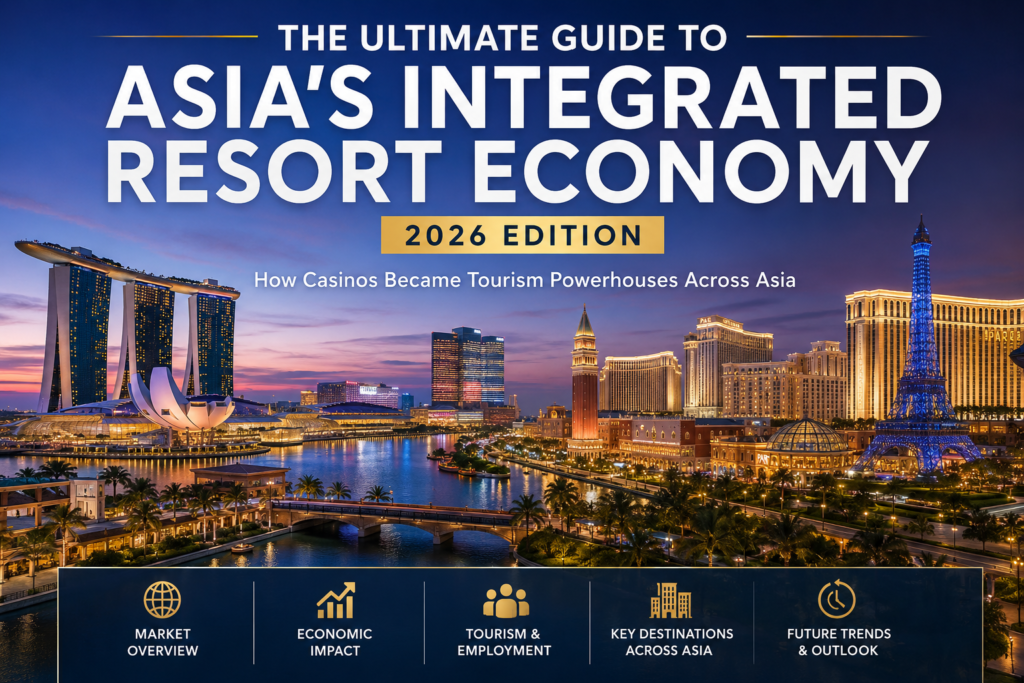
How Casinos Became Tourism Powerhouses Across Asia
For many people, the word “casino” still evokes images of gaming tables, slot machines and high-stakes gambling. Yet across Asia, the industry’s most successful developments have evolved into something far larger and more economically significant.
Today, the region’s leading gaming destinations are no longer simply casinos. They are integrated resorts, large-scale developments that combine hospitality, entertainment, retail, dining, convention facilities, attractions and gaming under a single destination brand.
From the skyline-defining resorts of Singapore to the vast entertainment complexes of Macau and the rapidly expanding integrated resorts of the Philippines, Asia has become home to some of the world’s most ambitious tourism developments.
In many cases, gaming represents only one component of a broader economic ecosystem that attracts millions of visitors, supports employment, stimulates investment and contributes significantly to national tourism strategies.
This guide explores the evolution of Asia’s integrated resort economy, the destinations driving its growth and the trends shaping its future.
What Is an Integrated Resort?
An integrated resort (IR) is a large-scale destination development that combines gaming facilities with a wide range of non-gaming attractions.
Typically, an integrated resort may include:
- Luxury hotels
- Convention and exhibition centres
- Entertainment venues
- Restaurants and fine dining
- Retail shopping districts
- Family attractions
- Wellness and spa facilities
- Nightlife venues
- Event spaces
- Gaming facilities
The objective is not simply to attract gamblers but to create a destination capable of attracting tourists, business travellers, event organisers, families and international visitors.
This approach has transformed the role of casinos within the tourism industry.
Rather than functioning as standalone gaming venues, casinos increasingly operate as anchor attractions within larger tourism ecosystems.
The Evolution of Gaming in Asia
The growth of Asia’s gaming industry has occurred over several decades.
Whilst gambling has existed in various forms throughout the region for centuries, the modern integrated resort model is relatively recent.
The industry’s development can broadly be divided into several phases:
Phase One: Traditional Gaming Markets
Markets such as Macau established themselves primarily through gaming activity.
During the early years of development, gaming revenue represented the overwhelming majority of economic activity.
Phase Two: Tourism Diversification
Governments increasingly recognised the potential of integrated resorts to stimulate broader economic development.
Investment shifted towards:
- Tourism
- Hospitality
- Retail
- Entertainment
- Meetings and conventions
Phase Three: Destination Development
Integrated resorts became central components of national tourism strategies.
The focus expanded beyond gaming to destination branding, visitor experience and economic diversification.
Phase Four: Experience Led Resorts
Today, many of Asia’s leading resorts compete on experience rather than gaming alone.
Entertainment, luxury hospitality, culinary offerings and unique attractions increasingly drive visitor demand.
Macau: From Gaming Hub to Global Tourism Destination
No discussion of Asia’s integrated resort economy would be complete without Macau.
Often referred to as the world’s largest gaming market, Macau transformed from a regional gambling destination into a globally recognised tourism and entertainment hub.
Developments across the Cotai Strip fundamentally changed the city’s tourism offering.
Major resort developments introduced:
- Luxury accommodation
- International entertainment
- Convention facilities
- Retail destinations
- Fine dining
- Family attractions
This diversification helped broaden Macau’s appeal beyond traditional gaming visitors.
Today, Macau remains one of the most significant examples of how integrated resorts can influence urban development, tourism growth and international investment.
Singapore: The Global Benchmark
Many industry observers regard Singapore as the benchmark for integrated resort development.
The introduction of large-scale integrated resorts represented a carefully managed strategy designed to strengthen tourism while maintaining regulatory oversight.
The results have been significant.
Integrated resorts in Singapore have contributed to:
- Increased international visitor arrivals
- Enhanced tourism spending
- Expanded convention business
- Employment creation
- International destination branding
Importantly, Singapore demonstrated that gaming could be positioned as one component within a broader tourism framework rather than the primary focus.
This model continues to influence policymakers throughout Asia.
The Philippines: Asia’s Fastest Growing Integrated Resort Market
The Philippines has emerged as one of the region’s most dynamic gaming and tourism markets.
Large-scale integrated resort developments have transformed parts of Manila into internationally recognised entertainment destinations.
The market benefits from:
- Strong tourism growth
- International accessibility
- Expanding hospitality infrastructure
- Competitive investment conditions
Integrated resorts have become major contributors to tourism activity, employment and economic development.
As regional tourism continues to recover and expand, the Philippines is expected to remain one of Asia’s most closely watched gaming markets.
Cambodia: An Emerging Destination
Cambodia has developed a significant gaming sector focused primarily on international visitors.
Locations such as Phnom Penh and border regions have attracted substantial investment in hospitality and gaming infrastructure.
Whilst the market remains smaller than Macau or Singapore, Cambodia illustrates how gaming developments can contribute to tourism and investment growth in emerging markets.
The long-term direction of the market will likely depend upon regulatory stability, infrastructure development and tourism demand.
Vietnam: Gradual Expansion and Long-Term Potential
Vietnam continues to attract attention as one of Asia’s most promising tourism destinations.
The country’s rapidly growing visitor economy, expanding infrastructure and rising international profile have generated interest in integrated resort development.
Although the regulatory environment continues to evolve, Vietnam possesses several characteristics that support long-term growth:
- Strong tourism demand
- Coastal resort destinations
- Growing hospitality sector
- Expanding international connectivity
Many industry observers believe Vietnam may become one of the region’s most significant integrated resort markets over the coming decade.
Sri Lanka: A Market to Watch
Sri Lanka is increasingly being discussed within regional tourism and gaming circles.
The country’s strategic location, tourism appeal and ongoing investment in hospitality infrastructure create opportunities for future integrated resort development.
Potential strengths include:
- Strong tourism assets
- Established hospitality sector
- Growing international visitor interest
- Strategic position within the Indian Ocean region
Whilst still developing as a gaming destination, Sri Lanka remains a market that many industry stakeholders continue to monitor closely.
Japan: The Next Major Chapter
Japan represents one of the most anticipated developments in the global integrated resort sector.
The country’s approach has focused on creating carefully regulated integrated resort developments designed to support tourism, investment and economic growth.
The scale of opportunity is significant.
Japan offers:
- One of the world’s largest tourism markets
- Strong infrastructure
- Global destination appeal
- Major convention and event potential
The successful implementation of Japan’s integrated resort strategy could influence gaming policy throughout Asia for years to come.
The Economic Impact of Integrated Resorts
Integrated resorts generate economic benefits that extend far beyond gaming revenue.
Key contributions include:
Employment
Integrated resorts create jobs across numerous sectors:
- Hospitality
- Tourism
- Entertainment
- Retail
- Food and beverage
- Security
- Facilities management
- Events and conventions
Tourism Spending
Visitors contribute to local economies through:
- Accommodation
- Dining
- Shopping
- Entertainment
- Transportation
Infrastructure Investment
Large-scale resort developments often stimulate broader investment in:
- Airports
- Roads
- Public transport
- Urban development
- Tourism facilities
Government Revenue
Integrated resorts may contribute through:
- Taxes
- Licensing fees
- Tourism related economic activity
The Rise of Casino Tourism
Casino tourism has become a significant component of Asia’s broader tourism economy.
Modern visitors increasingly seek comprehensive destination experiences.
Successful integrated resorts therefore focus on:
- Luxury accommodation
- Unique entertainment
- Culinary experiences
- Wellness offerings
- Cultural attractions
- Family friendly activities
This evolution has broadened the appeal of gaming destinations and expanded their economic contribution.
The Future of Asia’s Integrated Resort Economy
Several trends are likely to shape the next phase of development.
Greater Diversification
Non-gaming revenue is expected to become increasingly important.
Smart Destination Technology
Integrated resorts are investing in digital guest experiences and operational efficiency.
Sustainability
Environmental performance is becoming a growing consideration for resort developments.
Experience Led Tourism
Future success will increasingly depend upon creating memorable visitor experiences rather than simply expanding gaming capacity.
New Markets
Emerging jurisdictions may continue exploring integrated resort development as part of wider tourism and economic strategies.
Conclusion
Asia’s integrated resort economy has evolved far beyond traditional casino operations.
Today, integrated resorts serve as tourism anchors, employment generators, investment catalysts and destination brands.
From Macau’s transformation into a global entertainment hub to Singapore’s internationally recognised model and the continued growth of markets such as the Philippines, Vietnam, Cambodia, Sri Lanka and Japan, integrated resorts are playing an increasingly important role in shaping Asia’s tourism landscape.
As governments seek new ways to attract investment, diversify tourism and stimulate economic growth, integrated resorts are likely to remain an important part of the region’s development story.
For investors, operators, policymakers and travellers alike, understanding Asia’s integrated resort economy is no longer simply about gaming. It is about understanding one of the most significant tourism and hospitality trends shaping the region today.