
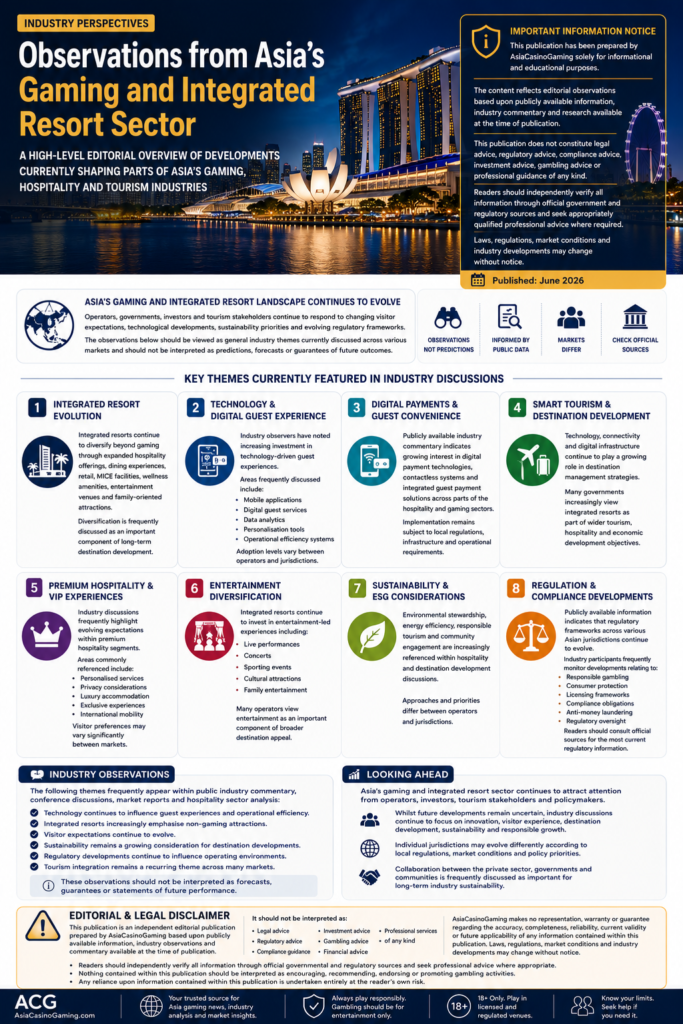
A High-Level Editorial Overview of Developments Currently Shaping Parts of Asia’s Gaming, Hospitality and Tourism Industries
Important Information Notice
This article has been prepared by AsiaCasinoGaming solely for general informational and educational purposes.
The content represents an editorial overview of publicly available information, industry observations and commentary regarding developments that may influence the gaming, hospitality and integrated resort sectors across Asia.
This publication should not be interpreted as a forecast, prediction, guarantee or statement of future performance.
Nothing contained within this article constitutes legal advice, regulatory advice, financial advice, investment advice, gambling advice or professional guidance of any kind.
Readers should independently verify information through official sources and appropriately qualified advisers before making any business, investment, travel or operational decisions.
Introduction
Asia’s gaming and integrated resort sector continues to evolve as operators, governments, investors and tourism stakeholders respond to changing visitor expectations, technological developments and broader economic trends.
Whilst every jurisdiction is unique, several recurring themes continue to emerge across discussions relating to gaming, hospitality, tourism and destination development throughout the region.
This article explores some of the developments currently attracting attention from industry participants and observers.
The observations outlined below are intended to provide context rather than certainty, recognising that individual markets may evolve in different ways over time.
The Continuing Evolution of Integrated Resorts
One of the most significant developments observed across Asia is the continuing expansion of the integrated resort concept.
Modern resorts increasingly seek to attract a broad range of visitors through:
- Luxury accommodation
- Dining experiences
- Retail offerings
- Entertainment venues
- Convention facilities
- Wellness amenities
- Family attractions
In many destinations, non-gaming experiences are becoming increasingly important components of the overall visitor proposition.
Industry discussions frequently focus on how integrated resorts can contribute to wider tourism objectives whilst supporting broader economic activity.
Technology and Digital Guest Experiences
Technology continues to play an increasingly visible role throughout the hospitality and gaming sectors.
Industry participants frequently discuss developments relating to:
- Mobile applications
- Digital guest services
- Data analytics
- Customer experience platforms
- Digital payments
- Operational efficiency tools
The extent to which individual operators adopt new technologies may vary significantly between jurisdictions and organisations.
However, technology remains a recurring theme within industry conversations across the region.
Cashless and Digital Payment Ecosystems
Across the wider tourism and hospitality landscape, digital payment systems continue to receive significant attention.
Industry observers frequently note growing interest in:
- Mobile payments
- Contactless transactions
- Digital wallets
- Integrated payment platforms
The adoption of such systems is influenced by local regulations, consumer preferences, technological infrastructure and operational considerations.
As a result, implementation approaches differ considerably between markets.
Changing Visitor Expectations
Modern travellers often seek experiences that extend beyond traditional hospitality offerings.
Industry commentary increasingly highlights demand for:
- Personalised experiences
- Unique entertainment
- Cultural engagement
- Wellness facilities
- Premium dining
- Lifestyle experiences
Integrated resorts are frequently discussed as destinations that combine multiple experiences within a single location.
The VIP Segment Continues to Evolve
The premium hospitality and VIP visitor segment remains an area of ongoing industry interest.
Discussions frequently focus on:
- Personalised services
- Privacy considerations
- Luxury experiences
- International mobility
- Relationship-driven hospitality
Whilst market conditions vary between jurisdictions, many operators continue to explore ways of enhancing premium visitor experiences.
Entertainment as a Destination Driver
Many integrated resorts increasingly position entertainment as a central component of their visitor offering.
Examples often include:
- Live performances
- Concerts
- Cultural events
- Sporting events
- Family attractions
- Themed experiences
This diversification reflects broader efforts to attract visitors with a range of interests rather than focusing exclusively on gaming-related activities.
Sustainability and Responsible Development
Sustainability continues to receive growing attention across the hospitality and tourism sectors.
Industry discussions increasingly reference:
- Environmental performance
- Energy efficiency
- Resource management
- Community engagement
- Responsible tourism
- Long-term destination stewardship
Many stakeholders view sustainability considerations as becoming increasingly relevant to large-scale destination development.
Regulation Remains an Important Consideration
Regulatory frameworks continue to influence how gaming and hospitality markets operate throughout Asia.
Publicly available information suggests that many jurisdictions continue to review areas such as:
- Consumer protection
- Responsible gambling measures
- Licensing frameworks
- Compliance requirements
- Anti-money laundering measures
- Operational oversight
As regulatory environments evolve, industry participants continue to monitor developments closely.
Readers should always consult official governmental and regulatory sources for the most current information.
Expert Perspectives Across the Industry
Although opinions differ, several themes frequently appear in commentary from hospitality, tourism and gaming professionals:
- Diversification beyond gaming continues to attract attention.
- Technology is increasingly influencing visitor experiences.
- Tourism and hospitality integration remains important.
- Sustainability is receiving greater consideration.
- Regulatory developments continue to shape operating environments.
- Visitor expectations continue to evolve.
These observations should not be interpreted as predictions but rather as recurring themes currently discussed across various parts of the industry.
Conclusion
Asia’s gaming and integrated resort sector remains one of the most dynamic components of the region’s tourism and hospitality landscape.
Whilst no one can predict the future with certainty, a number of themes continue to feature prominently within industry discussions.
Technology, integrated resort development, visitor experience, sustainability, entertainment and regulatory considerations all remain areas of ongoing interest.
As always, developments will vary significantly between jurisdictions, operators and markets.
For that reason, industry observations should be viewed as part of a broader conversation rather than definitive forecasts regarding future outcomes.
Editorial Disclaimer
This article is an independent editorial publication prepared by AsiaCasinoGaming based upon publicly available information, industry observations and commentary available at the time of writing.
The content is intended solely for informational and educational purposes and should not be interpreted as a prediction, forecast, guarantee, recommendation, endorsement or professional advice.
AsiaCasinoGaming makes no representation, warranty or guarantee regarding future market developments, business performance, investment outcomes, regulatory changes or industry trends.
Readers should undertake their own independent research and seek appropriate professional advice before making any business, investment, travel, operational or gambling-related decisions.
Nothing contained within this publication should be interpreted as encouraging, recommending or promoting gambling activities.
Any reliance upon information contained within this publication is undertaken entirely at the reader’s own risk.