Understanding How Different Asian Jurisdictions Approach Casino and Gaming Regulation
Important Information Notice
This article has been prepared by AsiaCasinoGaming solely for general informational and educational purposes.
The content provides a high-level editorial overview of publicly available information relating to gambling, casino and gaming regulation within selected Asian jurisdictions.
This publication is not intended to provide legal advice, regulatory advice, compliance advice, gambling advice, investment advice or professional guidance of any kind.
Gambling laws, regulations and governmental policies may change frequently and may vary according to individual circumstances, nationality, residency status, location and the specific activity concerned.
Readers should always consult official government sources, regulatory authorities and appropriately qualified legal professionals before relying upon any information contained within this publication.
Where official governmental information differs from any information presented in this article, official sources shall prevail.
Asia’s Diverse Regulatory Landscape
Asia is home to some of the world’s most varied approaches to gambling and casino regulation.
Whilst certain jurisdictions have established large-scale integrated resort industries that form part of broader tourism and hospitality strategies, others maintain strict restrictions or prohibitions on gambling-related activities.
As a result, there is no single Asian gambling model.
Instead, regulatory approaches differ significantly depending upon local legislation, government policy objectives, tourism strategies, cultural considerations and economic priorities.
Understanding these differences provides useful context for travellers, industry observers, investors, hospitality professionals and those seeking to better understand the region’s gaming landscape.
Why Gambling Regulation Differs Across Asia
Each jurisdiction determines its own approach to gambling regulation.
Publicly available information indicates that governments may consider a range of factors when developing gaming policy, including:
- Tourism development
- Economic diversification
- Consumer protection
- Responsible gambling measures
- Cultural considerations
- Religious considerations
- Investment objectives
- Regulatory oversight
Consequently, neighbouring jurisdictions may operate under very different regulatory frameworks.
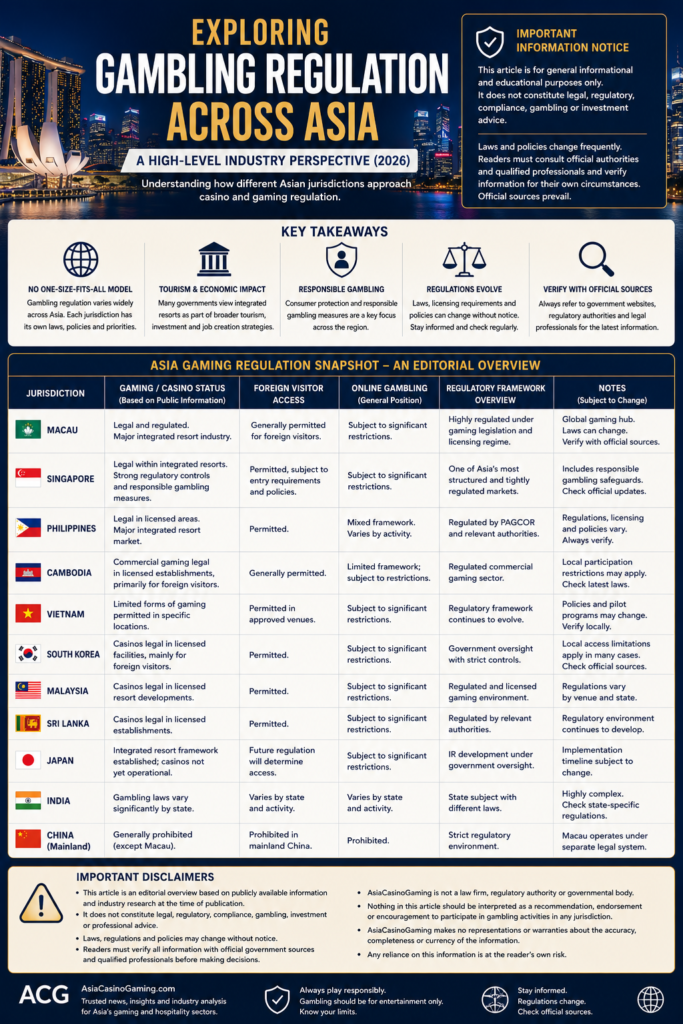
Selected Jurisdictions: An Industry Overview
The following summaries are intended only as high-level editorial observations based upon publicly available information.
Readers should independently verify all information through official sources.
Macau
Macau is widely recognised as one of the world’s most established gaming destinations.
Publicly available information indicates that the jurisdiction operates a structured gaming framework that supports a significant integrated resort sector and forms an important component of the local tourism economy.
Macau’s development has often been referenced internationally as an example of how gaming, hospitality, retail and entertainment can be combined within large-scale destination resorts.
Singapore
Singapore is frequently cited as one of Asia’s most closely regulated integrated resort markets.
Publicly available information suggests that gaming activities operate within a highly structured framework that incorporates tourism objectives alongside responsible gambling measures and regulatory oversight.
The integrated resort model adopted by Singapore is often viewed as a benchmark for destination-led development.
Philippines
The Philippines has emerged as one of Asia’s most significant integrated resort markets.
Publicly available information indicates that the country’s gaming sector forms part of a broader tourism and entertainment strategy, with several large-scale integrated resort developments attracting international attention.
The jurisdiction continues to be closely monitored by industry participants throughout the region.
Cambodia
Publicly available information suggests that Cambodia has developed a commercial gaming sector that primarily serves international visitors.
The country has attracted investment into hospitality and tourism infrastructure, particularly in locations associated with gaming and resort development.
As with all jurisdictions, regulatory frameworks continue to evolve over time.
Vietnam
Vietnam is frequently identified by industry observers as a market with long-term tourism and hospitality potential.
Publicly available information indicates that gaming-related policies have evolved over time and remain subject to ongoing regulatory development.
Many analysts continue to monitor Vietnam due to its growing tourism sector and broader economic development.
South Korea
South Korea operates a distinctive approach within the Asian gaming landscape.
Publicly available information suggests that gaming facilities exist within a broader tourism and entertainment framework and that regulatory controls play an important role in shaping the market.
The country continues to attract interest through integrated resort development and international tourism.
Malaysia
Malaysia has long maintained a presence within the region’s gaming and resort industry.
Publicly available information indicates that gaming activities operate within an established regulatory framework associated with licensed resort developments.
The country remains an important destination within the wider Asian tourism market.
Sri Lanka
Sri Lanka continues to attract interest as a tourism destination within the Indian Ocean region.
Publicly available information suggests that the hospitality and tourism sectors continue to evolve alongside broader investment and development initiatives.
Industry observers frequently discuss the country’s long-term tourism and integrated resort potential.
Japan
Japan represents one of the most closely watched markets within the global integrated resort sector.
Publicly available information indicates that the country has pursued a structured approach towards integrated resort development as part of broader tourism and economic objectives.
Many industry participants view Japan as an important future market within Asia’s hospitality and entertainment landscape.
Emerging Themes Across Asia
Although regulatory approaches differ significantly, several themes frequently appear across discussions relating to gaming regulation in Asia.
Tourism-Led Development
Many jurisdictions view integrated resorts as part of wider tourism strategies rather than standalone gaming developments.
Responsible Gambling Measures
Consumer protection and responsible gambling initiatives continue to receive increasing attention throughout the region.
Integrated Resort Growth
Large-scale resort developments continue to play a role in tourism, hospitality and destination branding strategies.
Regulatory Evolution
Gaming-related legislation and regulatory frameworks remain subject to review and change in a number of jurisdictions.
Economic Contribution
Integrated resorts are frequently discussed in the context of employment, tourism spending, infrastructure development and investment.
Why Official Sources Matter
Regulatory frameworks can change without notice.
Legislation may be amended.
Licensing conditions may change.
Government policy may evolve.
Regulatory guidance may be updated.
For this reason, readers should always consult:
- Official government websites
- Relevant regulatory authorities
- Official legislation
- Public regulatory notices
- Appropriately qualified legal professionals
before relying upon any information relating to gambling activities, travel decisions, business operations or regulatory compliance.
Conclusion
Asia’s gaming landscape remains one of the most diverse and dynamic in the world.
From established integrated resort destinations to emerging tourism markets, regulatory approaches vary considerably between jurisdictions.
Understanding these differences can provide useful context for industry observers, travellers and hospitality professionals.
However, gambling regulation is a complex and evolving subject.
Readers should therefore treat this article as a high-level editorial overview only and should always seek information directly from official authorities and qualified advisers where accuracy is important.
Editorial and Regulatory Information Disclaimer
This publication is intended solely as a general editorial overview of publicly available information relating to gambling, casino and gaming regulation within selected Asian jurisdictions.
AsiaCasinoGaming is an independent informational publishing platform and is not a law firm, regulatory authority, governmental body, compliance adviser or professional consultancy.
Nothing contained within this publication constitutes legal advice, regulatory advice, compliance guidance, gambling advice, investment advice or professional services.
AsiaCasinoGaming does not guarantee the accuracy, completeness, currency, reliability or applicability of any information contained within this publication.
Laws, regulations, licensing frameworks and governmental policies may change at any time and without notice.
Readers remain solely responsible for independently verifying all information through official governmental authorities, regulatory bodies and appropriately qualified professional advisers before making any legal, business, travel, investment or gambling-related decisions.
Nothing contained within this publication should be interpreted as encouraging, recommending, endorsing or promoting gambling activities in any jurisdiction.
Any reliance upon information contained within this publication is undertaken entirely at the reader’s own risk.